Construction projects rarely go exactly as planned. Unexpected repairs, owner-requested changes, emergency work, and unforeseen site conditions often require contractors to perform work that wasn’t included in the original contract.
The challenge isn’t just completing the extra work—it’s documenting it properly so you can get paid.
That’s where T&M Tickets (Time & Materials Tickets) come in.
Whether you’re a general contractor, specialty contractor, service contractor, or field technician, T&M Tickets provide the documentation needed to record labor, materials, equipment, and customer approvals for extra work performed on a project.
In this guide, you’ll learn:
- What T&M Tickets are
- What T&M means in construction
- When contractors use T&M Tickets
- What information every T&M Ticket should include
- The difference between paper and digital T&M Tickets
- Why more contractors are switching to digital T&M software
What Are T&M Tickets?
T&M Ticket (Time & Materials Ticket) is a document used to record the labor, materials, equipment, and other costs associated with work performed under a Time and Materials (T&M) agreement.
Instead of charging one fixed price, contractors bill customers based on:
- Labor hours worked
- Materials consumed
- Equipment used
- Agreed labor rates
- Material and equipment markups (if applicable)
A T&M Ticket serves as proof that the work was agreed to and approved, and provides the documentation needed for customer approval and billing.
Think of it as a detailed record of everything required to perform and get paid for or unforeseen work.
Why Are They Called Time & Materials Tickets?
The name comes directly from how contractors are paid.
Instead of billing a lump-sum price, they charge for:
- Time — labor hours spent completing the work
- Materials — products and supplies consumed during the job
Many contractors also include:
- Equipment usage
- Subcontractor costs
- Travel time
- Rental equipment
- Markup percentages
Everything is documented on the T&M Ticket before being approved by the customer.
What Information Does a T&M Ticket Include?
A complete T&M Ticket should capture all the information needed to support billing and reduce disputes.
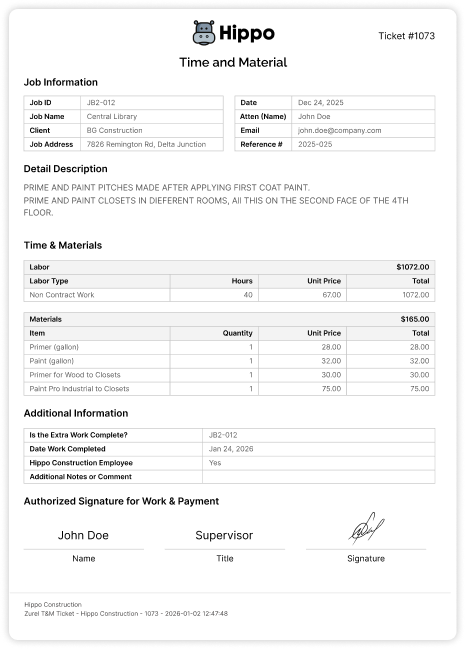
Typical information includes:
1.Project Information
- Project name
- Project number
- Job location
- Customer name
2. Date of Work
The exact date when the work was performed.
3. Labor
- Employee classification
- Hours worked
- Labor rates
4. Materials
- Material descriptions
- Quantities
- Unit costs
- Markups (if applicable)
5. Equipment
- Equipment used
- Hours of operation
- Equipment rates
6. Work Performed
A clear description of the additional work completed.
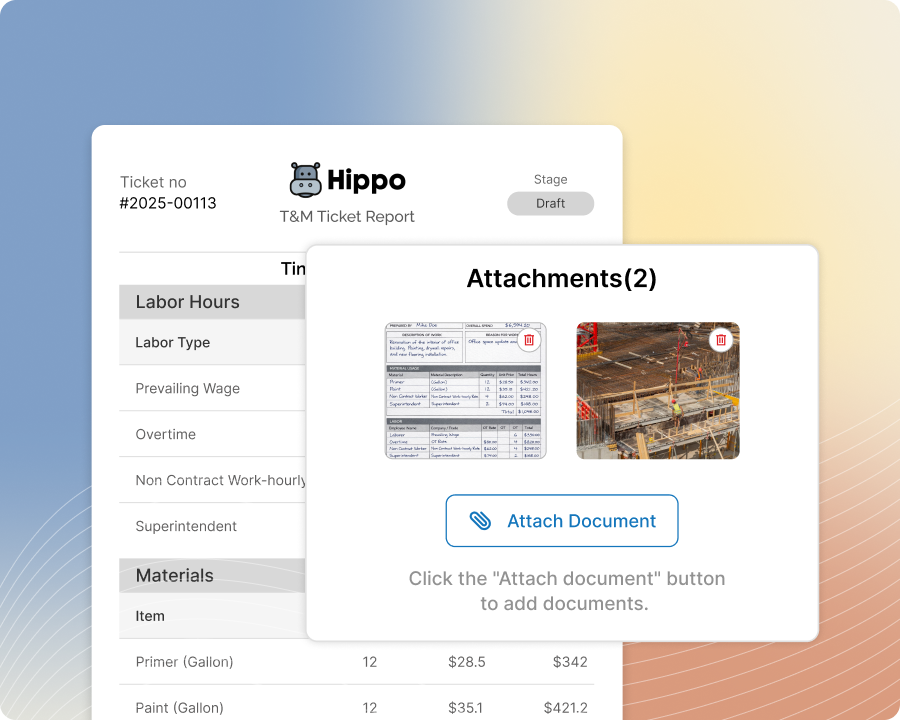
7. Photos
Supporting photos provide visual proof of the work performed. Include photos taken before, during, or after the work, such as site conditions, completed work, before-and-after comparisons, and scans of supporting documents like receipts or invoices.
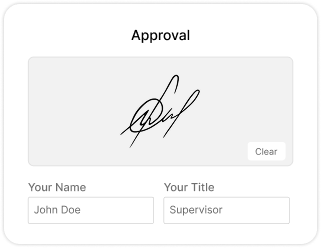
8. Customer Approval
- Signature
- Name
- Date
- Time
This approval confirms the customer acknowledges the work performed before invoicing.
When Are T&M Tickets Used?
T&M Tickets are commonly used whenever work falls outside the original contract or cannot be estimated accurately beforehand.
Typical situations include:
Change Orders
Additional work requested after construction begins.
Emergency Repairs
Urgent repairs where immediate action is required.
Unexpected Site Conditions
Hidden utilities, damaged structures, or unforeseen conditions discovered during construction.
Maintenance Work
Routine maintenance often varies depending on what technicians discover onsite.
Service Calls
Service contractors frequently bill using Time & Materials because every job is different.
Small Projects
Projects too small to justify detailed estimating.
Field-Directed Work
When owners or project managers authorize additional work directly in the field.
Why Are T&M Tickets Important?
Modern construction projects require modern tools to manage work efficiently. That’s where Time & Materials (T&M) tickets come in. Without accurate and consistent documentation, contractors risk:
- Delayed payments
- Billing disputes
- Lost revenue
- Forgotten labor hours
- Missing material charges
Accurate T&M Tickets help contractors:
- Document every billable item
- Reduce customer disputes
- Speed up invoicing
- Improve accountability
- Create a clear audit trail
Traditional Paper T&M Tickets vs Digital T&M Tickets
For decades, contractors relied on handwritten paper forms to document Time & Materials work. While paper tickets are familiar, they often create delays, errors, and administrative headaches.
Modern Digital T&M Tickets solve many of these problems by allowing field teams to record work directly from a mobile device and instantly share approved tickets with the office.
| Traditional Paper T&M Tickets | Modern Digital T&M Tickets |
| Handwritten forms | Digital forms on mobile devices |
| Easy to lose or damage | Secure cloud storage |
| Manual calculations | Automatic calculations |
| Difficult-to-read handwriting | Clear digital records and readable texts |
| Photos stored separately | Photos attached directly to the ticket |
| Customer signs on paper | Digital signature or QR-code approval |
| Office waits for paper copies | Instant access for the back office |
| Manual data entry | No duplicate entry |
| Slow billing process | Faster invoice preparation |
| Limited tracking | Real-time tracking and reporting |
Challenges with Traditional Paper T&M Tickets
Although paper tickets have been used for years, they create several common problems. Many contractors still depend on traditional paper T&M Tickets, even though there are many challenges and disadvantages.
Here are some challenges with them:
Lost or Damaged Tickets
Paper forms can easily be misplaced, damaged by weather, or lost during transportation.
Delayed Billing
The office cannot begin invoicing until paper tickets arrive from the jobsite.
Incomplete Information
Workers may forget labor hours, materials, or equipment used if tickets are filled out later.
Hard-to-Read Handwriting
Handwritten T&M tickets can be hard to read. This can cause misunderstandings, billing disputes.
Difficult Customer Approval
Customers aren’t always available when paperwork needs to be signed, resulting in delays.
Manual Office Work
Office staff often spend hours re-entering handwritten information into accounting or project management systems.
Benefits of Digital T&M Tickets
Digital T&M software modernizes the entire documentation process in construction projects.
Complete Tickets Faster
Field crews can record labor, materials, equipment, notes, and photos directly from the jobsite.
Get Customer Approval Immediately
Customers can review and sign tickets before leaving the site, reducing approval delays.
Reduce Billing Disputes
Digital signatures, timestamps, photos, and detailed work records provide stronger documentation.
Improve Accuracy
Automatic calculations eliminate math errors and ensure labor rates and markups are applied consistently.
Speed Up Billing
Approved tickets are instantly available to the back office, allowing invoices to be prepared much sooner.
Keep Everything Organized
Every ticket is stored securely and can be searched later by project, customer, or date.
Who Uses T&M Tickets?
T&M Tickets are commonly used by:
- General contractors
- Electrical contractors
- Painting contractors
- Drywall contractors
- Mechanical contractors
- HVAC contractors
- Plumbing contractors
- Civil contractors
- Utility contractors
- Restoration companies
- Maintenance contractors
- Service technicians
- Facility maintenance teams
Any contractor performing work billed by labor and materials can benefit from using T&M Tickets.
Best Practices for Managing T&M Tickets
To avoid disputes and improve billing efficiency:
- Complete tickets while work is being performed.
- Record labor, materials, and equipment accurately.
- Add clear descriptions of the work completed.
- Attach supporting photos whenever possible.
- Obtain customer approval before leaving the jobsite.
- Submit tickets promptly to the office.
- Store all documentation in a searchable digital system.
Following these practices helps create reliable records and supports faster, more accurate invoicing.
Conclusion
T&M Tickets are one of the most important documents for contractors performing extra work, service work, maintenance, or change orders. They provide the proof needed to justify labor, materials, and equipment charges while helping contractors reduce disputes and get paid accurately.
While traditional paper T&M Tickets have served the industry for years, they often slow down approvals, delay billing, and increase administrative work adds to financial risks. Digital T&M Tickets simplify the entire process by capturing work details in real time, collecting customer approvals on-site, and making approved tickets immediately available to the back office.
If you’re looking to replace paper T&M Tickets with a faster, more accurate solution, Zurel T&M Tickets helps contractors create digital Time & Materials Tickets, capture labor, materials, equipment, photos and authorization in one place, and streamline the entire approval-to-billing workflow. Whether your crews are using on-device signatures, QR code approvals, or remote approvals via email or text, Zurel helps you document every billable hour and get paid faster.
Request a Free demo to explore more about the product.
Frequently Asked Questions
About Author