
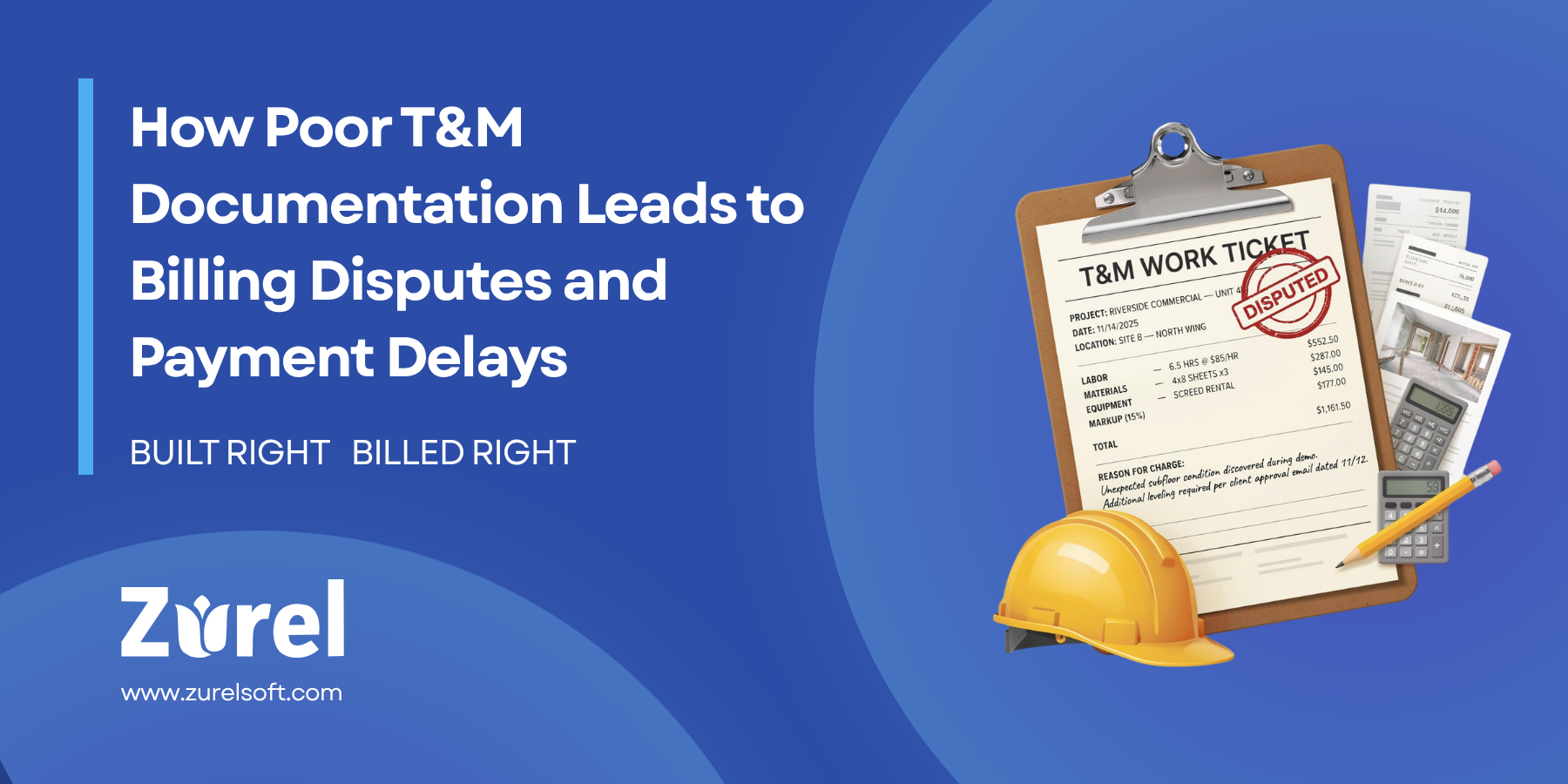
Time and material work often begins when a contractor encounters a change, an unexpected site condition, or additional work outside the original scope. Completing the work is only part of the process; contractors must also document what was done, why it was needed, which resources were used, and how the charges were calculated.
Poor T&M Documentation can make valid charges difficult to verify and lead to billing disputes. Missing details, unclear descriptions, incorrect costs, or limited supporting evidence may cause clients to question the ticket, delay approval, and slow invoice preparation. Clear documentation helps contractors support every billable cost and gives clients greater confidence in the charges.
What Is T&M Documentation?
T&M Documentation is the complete record used to support work billed on a time and materials basis. It includes details such as the work performed, labor hours, materials, equipment, rates, markups, dates, and project location.
It may also include photos, receipts, invoices, delivery slips, and client approval. A complete T&M Ticket should clearly explain what happened, why the work was needed, and how the final charges were calculated.
Why Clear T&M Documentation Matters
Clear T&M Documentation helps contractors show that additional work was completed and that the related charges are accurate. It gives clients the information they need to review the work with confidence and helps the back office prepare invoices without repeatedly contacting field employees for missing details.
Poor documentation can lead to questions, delayed approvals, and billing disputes. Well-documented T&M Tickets help support charges, reduce missed costs, speed up invoicing, and create a reliable record that can help prevent future disputes.
How Poor T&M Documentation Causes Billing Disputes
Unclear Work Descriptions
Descriptions such as “extra work,” “site changes,” or “additional labor” provide very little context.
A client reviewing the ticket may not understand what was completed, where the work occurred, or why it was outside the original scope.
A stronger description should explain:
- What changed
- Where the work was performed
- Why the work was needed
- Who requested or authorised it
- What the crew completed
Without this information, even valid work can appear unsupported.
Contractors can reduce these questions by using digital T&M Tickets to create clear, complete documentation.
Missing Labor Details
A ticket that only shows total labor hours may not give the client enough information to verify the charge. Details such as employee names, labor classifications, hours worked, and tasks completed provide a clearer record.
Missing labor information can also make it harder for the office team to confirm the correct rates. A structured digital process helps crews record these details while the work is happening.
Incorrect Rates and Markups
Manual pricing can lead to mistakes when crews use outdated rate sheets, apply incorrect markups, or select the wrong labor classification. If the ticket does not match the agreed pricing, the client may dispute the charge.
Giving field teams access to approved rates and markups helps reduce calculation errors and supports more consistent T&M billing.
Learn how digital T&M Tickets can help contractors use accurate rates and markups.
Missing Receipts and Supporting Documents
A lost receipt can prevent a contractor from recovering a cost they incurred.
For example, a crew may purchase materials needed to complete additional work but lose the receipt before it reaches the office. Without proof of the expense, the contractor may be unable to pass the cost to the client.
Invoices, receipts, delivery slips, drawings, and other supporting documents should remain connected to the relevant T&M Ticket.
Digital T&M records make it easier to attach supporting documents directly to the ticket.
Lack of Photo Evidence
Photos can help explain conditions that are difficult to describe in writing.
Before photos may show the unexpected site condition. Progress photos can document the work being completed, while after photos provide evidence of the finished result.
Without visual documentation, a client may question why the additional work was required or whether it was completed as described.
Keeping photos with the ticket helps contractors provide clearer visual documentation of T&M work.
Illegible Handwriting
Handwritten T&M Tickets can be difficult to read.
Unclear handwriting can lead to misread hours, quantities, costs, or work details. This creates extra back-office work and increases the risk of billing disputes. Digital T&M Tickets provide a clearer, more consistent record.
Missing Client Approval
Delayed approval can make it harder for clients to remember or verify the work. Without a clear approval record, they may later dispute whether the work was authorised or the costs were accepted.
Flexible digital approval methods can help contractors obtain timely T&M Ticket approvals.
Documentation Stored in Different Places
T&M records are often spread across multiple locations.
The paper ticket may remain in a truck, photos may be stored on a crew member’s phone, receipts may be sent through text messages, and approval may be buried in an email thread.
When documentation is fragmented, the office team must spend time collecting and matching the information before preparing an invoice.
Keeping descriptions, photos, documents, costs, and approvals connected to the same ticket creates a clearer and more reliable record.
The Business Impact of T&M Billing Disputes
A billing dispute can affect more than one invoice. Project managers, field employees, accounting teams, and administrators may need to search for receipts, request photos, review rates, contact crew members, or revise the ticket.
This can delay approvals and invoicing, increase administrative work, reduce client confidence, and lead to unbilled costs or lower profitability. Across multiple projects, even small documentation gaps can create significant financial delays.
A centralised digital process can help teams manage T&M Tickets and move approved work toward billing faster.
Example of a T&M Documentation Dispute
A contractor discovers an unexpected site condition and completes additional work to keep the project moving.
The crew records labor and materials on a handwritten T&M Ticket but only writes “additional site work” in the description. No photos are attached, the material receipt is lost, and the client does not sign the ticket at the jobsite.
Several weeks later, the charge appears on the invoice. The client asks why the work was necessary and requests proof of the material cost.
Because the documentation is incomplete, the contractor must contact the crew, search for supporting records, and try to reconstruct what happened. The invoice remains unpaid while the issue is reviewed.
A clear description, supporting photos, an attached receipt, and timely client approval could have prevented much of this delay.
What Complete T&M Documentation Should Include
A complete T&M record should include enough information for someone who was not at the jobsite to understand the work.
When possible or applicable, contractors should document:
- What work was completed
- Where the work occurred
- Why it was outside the original scope
- Who requested or authorised it
- Labor names, classifications, and hours
- Materials and quantities
- Equipment and usage time
- Applicable rates and markups
- Before, during, and after photos
- Receipts, invoices, drawings, and delivery slips
- Client approval
- Related project and ticket number
The goal is not to collect unnecessary paperwork. It is to create a clear record that supports the work and its cost.
How Digital T&M Documentation Helps Prevent Disputes
Record Work While It Is Happening
Field teams can record labor, materials, equipment, and work details while the information is still fresh.
This reduces the need to remember or reconstruct the work after returning to the office.
Contractors can create digital T&M Tickets directly from the field and make the information available to the back office sooner.
Keep Documentation Connected to the Ticket
Digital T&M Tickets allow teams to keep descriptions, photos, receipts, drawings, delivery slips, and other supporting files with the same record.
The back office can review the complete ticket without searching through emails, text messages, folders, or paper forms.
Provide Visual Proof
Before, during, and after photos provide visual context for the work.
Teams can also mark up photos to identify the affected area or highlight an important condition. This makes the ticket easier for the client to review and understand.
Digital documentation helps crews add photos and supporting evidence to T&M Tickets.
Use Consistent Rates and Markups
Established rates and markup settings can be made available to the field team.
This reduces inconsistent pricing, manual calculations, and reliance on outdated rate sheets.
Collect Approval Earlier
Digital approval options make it easier to request approval while the work is still familiar to the client.
Depending on the process, clients may approve a ticket in person, scan a QR code, or open an approval request electronically.
Faster approval creates a stronger record and allows the ticket to move toward billing sooner.
Give the Back Office Faster Access
Digital tickets do not need to be physically transported from the jobsite to the office.
Once submitted, the information can become available to authorised office employees for review, correction, approval tracking, and invoice preparation.
Centralized ticket management helps contractors track T&M Tickets and accelerate billing.
Can Better T&M Documentation Eliminate Every Dispute?
Better documentation cannot guarantee that a client will never question a charge.
However, it makes disputes easier to prevent and resolve.
When a contractor can quickly provide a clear work description, accurate labor and material details, photos, receipts, applicable rates, and an approval record, there is less uncertainty surrounding the invoice.
The objective is not simply to produce more documentation. It is to create documentation that is complete, relevant, organised, and easy to review.
How Zurel Helps Improve T&M Documentation
Zurel T&M Tickets helps contractors create a clear and connected digital record of additional work from the jobsite through approval and billing.
Field teams can document labor, materials, equipment, and work details while the work is happening. They can add before, during, and after photos, upload receipts and other supporting files, and use photo markups to highlight important details.
Established rate and markup information can help teams calculate costs consistently. Flexible approval options can help contractors obtain client approval sooner, while centralised ticket records give the back office faster access to the information needed for billing.
By keeping work details, supporting evidence, costs, and approvals together, Zurel helps contractors create clearer T&M Documentation and reduce avoidable billing questions.
Learn more about how Zurel helps contractors build clear documentation into every T&M Ticket.
Conclusion
Poor T&M Documentation can turn legitimate additional work into a disputed charge.
With Zurel T&M Tickets, field and office teams can keep work descriptions, labor, materials, equipment, photos, documents, rates, and approvals connected in one digital workflow. This creates a stronger record from the moment additional work begins through final billing.
Explore more about Zurel’s Time and Material Tickets for Construction for better T&M Documentation.
About Author